Auto Acoustics

Car Stereo and Window Tint

(919) 493-5473 Celebrating 35 Years!
  • Home
  • Services
    • ATV/UTV Upgrades
    • Car Audio
    • Driver Safety
    • Jeep Accessories
    • Marine Audio and Lighting
    • Motorcycle Audio
    • Remote Starters
    • Truck Accessories
    • Window Tint
  • About Us
  • Location
  • Customer Reviews
  • Contact Us
  • Work For Us
  • Facebook
  • Instagram

How Do Laser Shifter Systems Work?

Laser Shifter

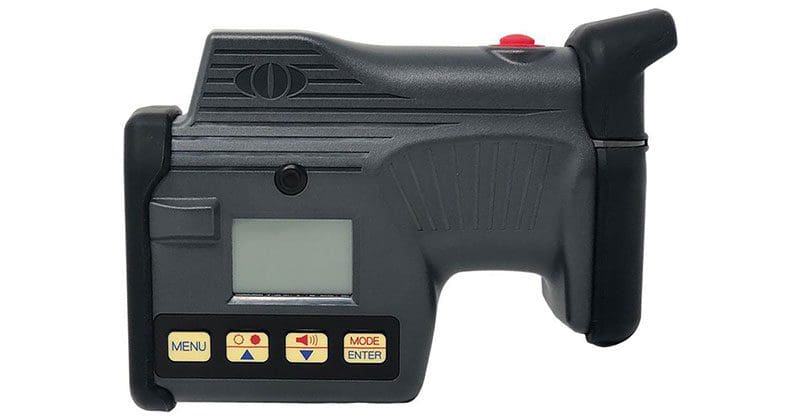
Sold as a means of preventing police officers from measuring the speed of your vehicle, laser shifter systems are amazing feats of engineering. Laser-based speed measurement guns measure distances very accurately and very quickly. Police use these hand-held guns to pick out a single vehicle in heavy traffic and find out in a split second how fast it’s going. With no time to slow down, a laser shifter system is your only hope of not getting a ticket – assuming you are traveling above the speed limit.

How Do Police Laser Systems Work?

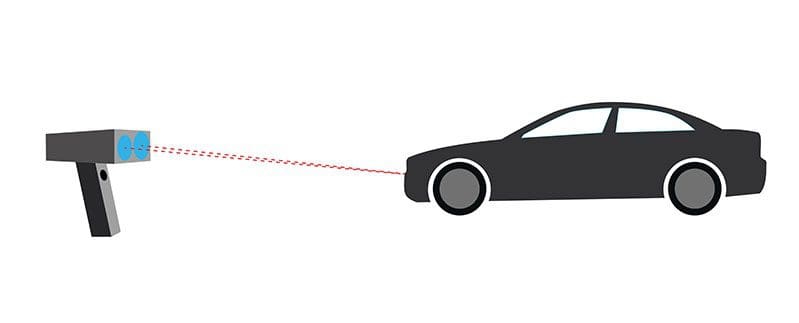
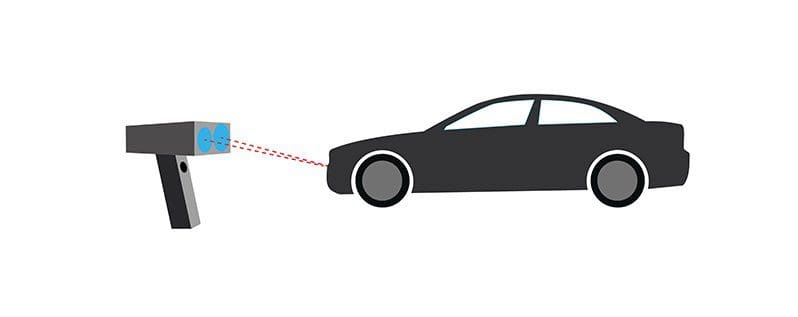
Police laser guns emit a series of narrowly focused light pulses at a target. The system measures the time it takes for those pulses to reflect back to the gun. Knowing the speed of light, the gun can calculate how far away the object is. If the series of pulses arrives back to the gun at an increasingly faster rate, the object is getting closer to the gun. If the time between pulse reflections is slower, the object is moving away. Using calculus (that math you learned in high school but never thought was necessary), the gun can calculate the vehicle speed, often in less than 0.3 of a second.

Laser Shifter
Police laser guns transmit a series of light pulses to determine your distance.

How Do Laser Defusers Work?

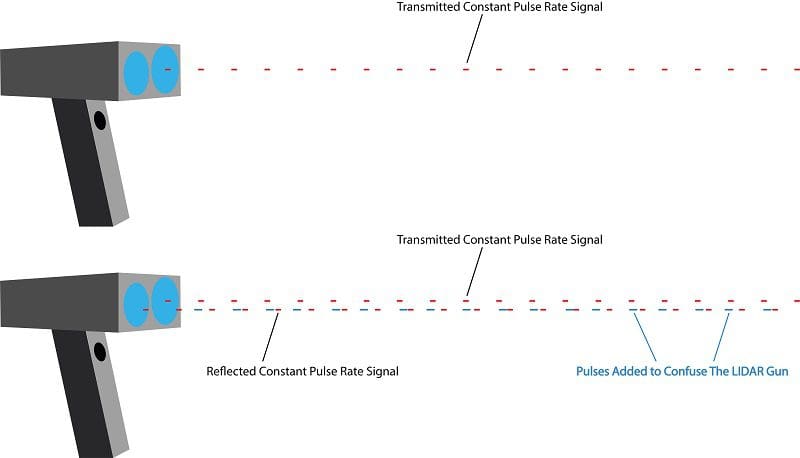
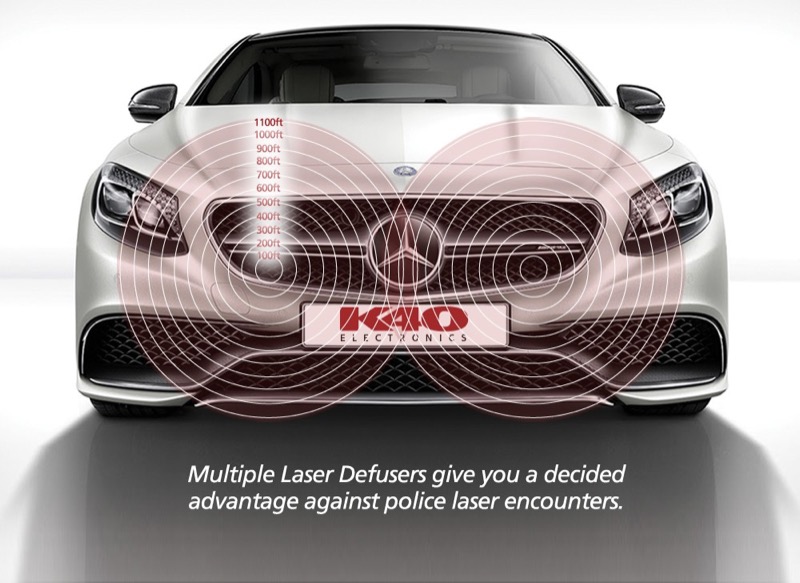
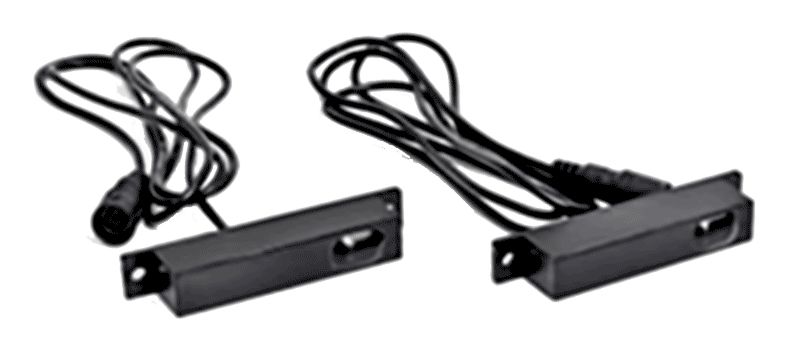
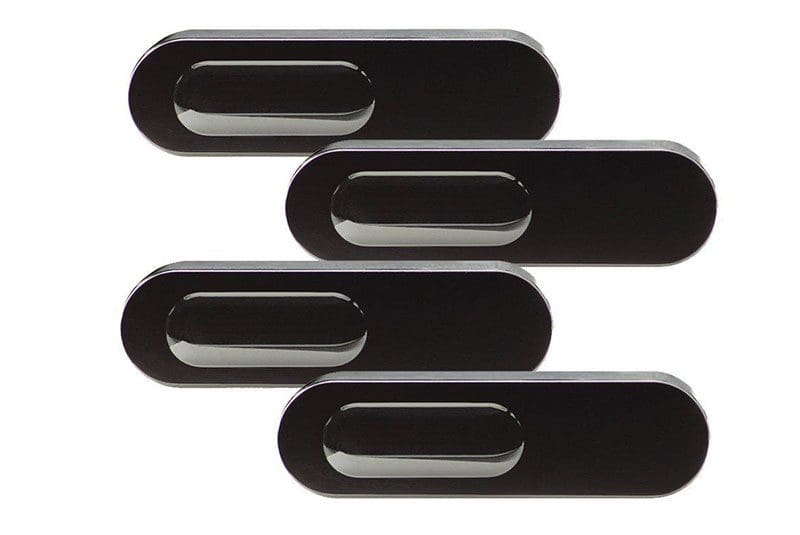
The laser defuser system uses a pair (or more) of transceivers on the front (and optionally the rear) of your vehicle to detect the light pulses from the laser gun. The transceivers have IR receivers that are similar to those used to detect signals from your TV remote control. As soon as the system detects a signal, it sets to work analyzing the pattern of pulses to determine what type of laser gun is being used. It compares the pattern to a look-up table and immediately starts broadcasting light pulses that are similar, but not identical, to those it received. This process happens in less time than it takes the gun to measure the vehicle speed. The pattern of confusing light signals and reflections from the vehicle prevents the laser gun from accurately determining your distance or speed.

Laser Shifter
The laser shifter system emits light pulses to confuse the information that the laser gun receives and prevent it from displaying your vehicle speed.

How Do We Use Laser Defuser Systems?

Laser ShifterThe key to being able to continue driving without interruption lies in how your laser shifter system is used, more than what it does. As soon as the system detects a signal, you will receive an alert so that you can start to slow down. Once at a safe speed, you can cancel the shifted signal transmission and allow the officer to take a reading.

The speed at which you complete the “slow and cancel” process is crucial to your success. If you lollygag and drive past the officer with the laser signal shifted, he or she will know what you are up to and may choose to follow you.

A smooth but efficient application of the brakes to prevent the nose of the car or truck from dipping, then a subsequent tap on the Mute (or similar) button should take no more than a few seconds. The officer will likely be in the process of taking a second measurement of your vehicle and, if you’ve done your job, will get a reading that won’t raise an eyebrow.

Laser Shifter
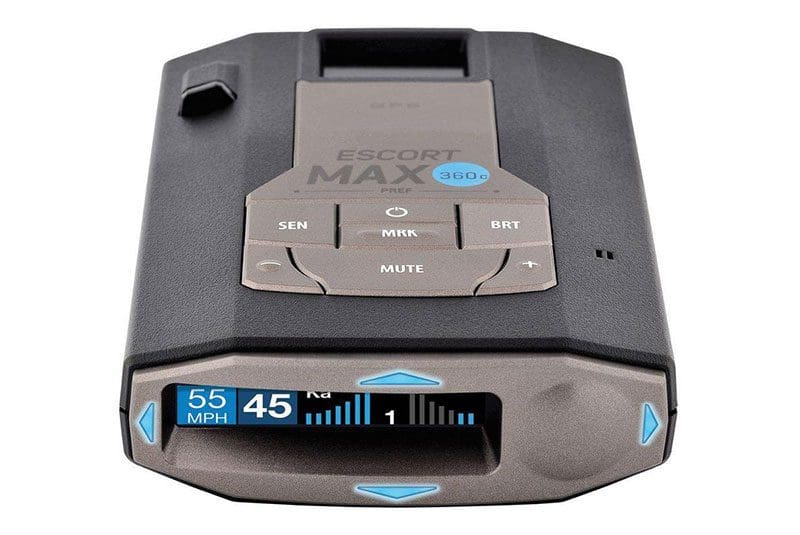
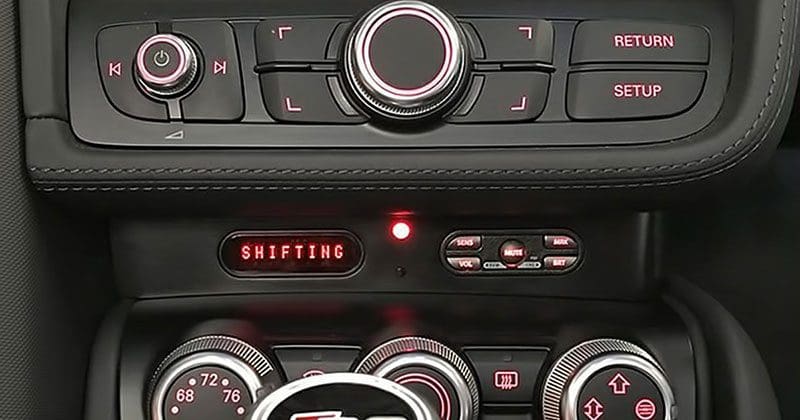
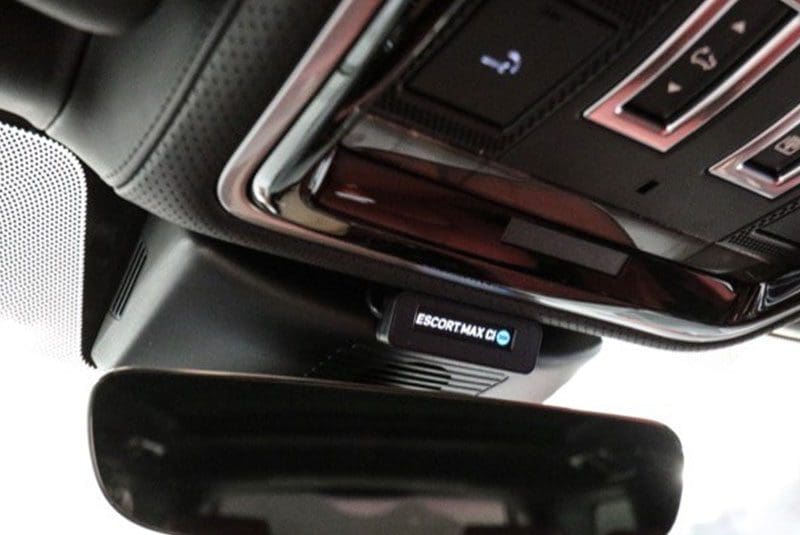
A beautifully integrated display from an Escort MAX Ci 360 in the overhead console of a Range Rover. Image courtesy of Ralph’s Radio in Vancouver, British Columbia.

Expert Installation Is Required

Laser ShifterOne final point we want to highlight is the importance of proper installation. Laser defusers, shifters, sensors, transceivers or whatever you choose to call them require very accurate installation. If they aren’t aligned perfectly and positioned according to manufacturer guidelines, the system may not function properly. Done wrong, your investment in protection will be rendered useless.

As with most premium automotive enhancements, choosing a retailer who has the tools, training and materials to complete the installation properly should take significant precedence over any other aspect of the project. Ask to see examples of their work and, if possible, have a look behind the scenes at how they mount components, run wiring and make connections. If it doesn’t look right to you, it probably isn’t.

Our team asks that you always obey all traffic laws and drive carefully at all times.

This article is written and produced by the team at www.BestCarAudio.com. Reproduction or use of any kind is prohibited without the express written permission of 1sixty8 media.

Filed Under: ARTICLES, Radar Detectors, RESOURCE LIBRARY

How Does a Police Radar Gun Work?

Police Radar

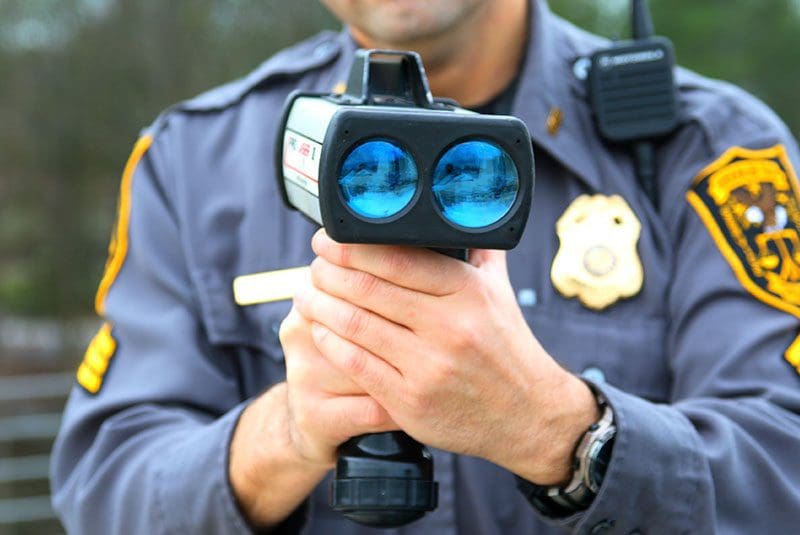
Police officers in North America have been using radar guns to catch speeders since 1949. This relatively simple technology evolved from military applications before World War II, where long-range installations were the size of a medium-size apartment building. Modern radar guns aren’t quite pocket-sized, but they are easily transportable and can be hand-held or installed permanently in a police vehicle. Let’s look at how a radar gun works.

How Does Speed-Detecting Radar Work?

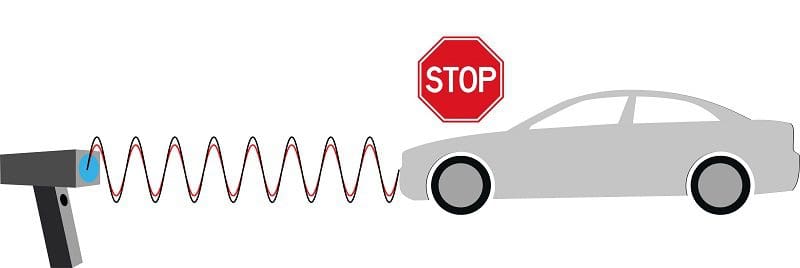
In simple terms, a radar gun transmits a narrow beam of radio-frequency energy out the front of the gun and looks for that signal to be reflected back to the gun after bouncing off an object. Unlike lidar and laser guns, the speed measurement is calculated by how much the received signal has changed in frequency after reflecting off the moving object. This phenomenon is called a Doppler effect and is the same reason that a car sounds different as it approaches and drives away from you.

Police Radar
Radio frequency signals bouncing off a stationary object are reflected to the source at the same frequency.

Please Explain Doppler Effect to Me!

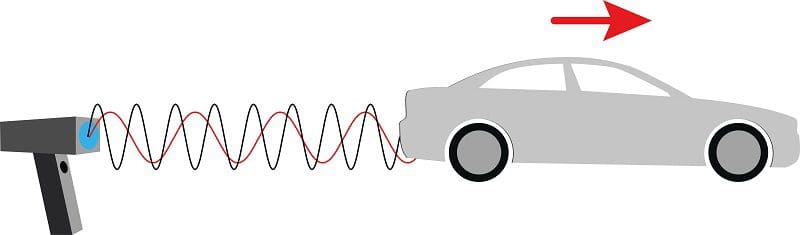
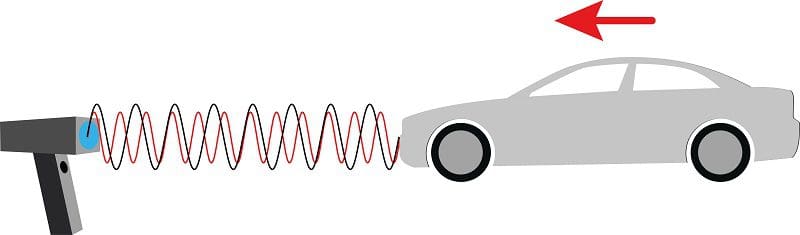
Imagine that you have a tennis ball machine shooting balls at a stationary object once every second. The balls bounce back to the machine and arrive once per second. If you start to move the object toward the ball launching machine, the balls bounce back faster and faster as the object approaches the machine. This increase in return speed represents an increase in frequency.

Police Radar
Radio frequencies that bounce off of an object moving away from the radar gun are reflected at a lower frequency.

If an object is moving away from the tennis ball machine, it will take longer for each ball to bounce back, thus representing a decrease in frequency. The digital signal processor in modern radar guns is configured to analyze the changes in the reflected signal very quickly and display a speed reading in less than a second.

Police Radar
Radio frequencies that bounce off of an object moving toward the radar gun are reflected at a higher frequency.

Different Radar Bands

Police RadarIn North America, police officers use radar guns that operate in the X, K and Ka band frequency ranges. X band is the oldest technology and operates between 8 and 12 GHz; the K band is between 18 and 27 GHz; and the Ka band is between 27 and 40 GHz. X band radar is prone to interference from automatic door opening systems. K band (K is short for Kurz, which is the German word for short) and Ka (K-above band) radar are less resistant to atmospheric absorption than X band and less effective over long distances. Most of the new radar guns such as the Stalker II and the Kustom Talon use Ka band signals, so if your detector goes off, you know you need to react right away.

Radar Detectors Provide Early Warnings

Unlike lidar, the radar signal isn’t as precise at long distances, allowing it to spread well beyond the vehicle being measured. The high-sensitivity radar receiver in a radar detector is tuned to pick up extremely low-level signals and alert you that radar is in use. You need to act quickly when a radar detector goes off. Your local specialist mobile enhancement retailer can help you choose the perfect portable or custom-installed radar for your application and ensure that the system is installed cleanly. Drop by and find out what’s available today!

This article is written and produced by the team at www.BestCarAudio.com. Reproduction or use of any kind is prohibited without the express written permission of 1sixty8 media.

Filed Under: ARTICLES, PRODUCTS, Radar Detectors, RESOURCE LIBRARY

How Does a Police Laser Gun Work?

Police Laser

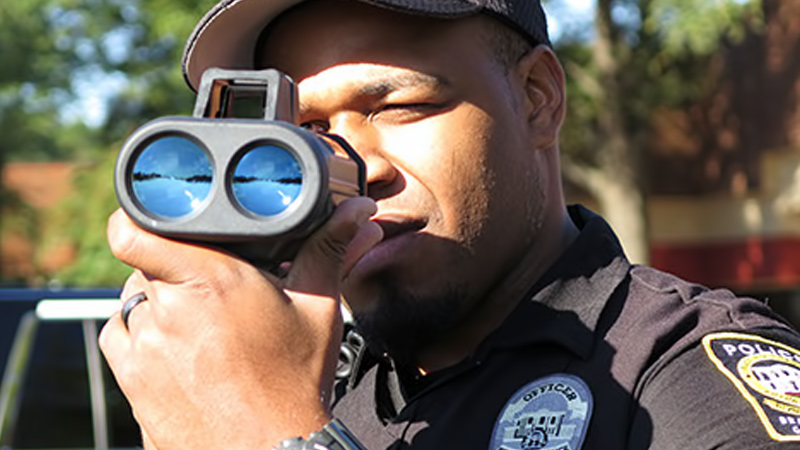
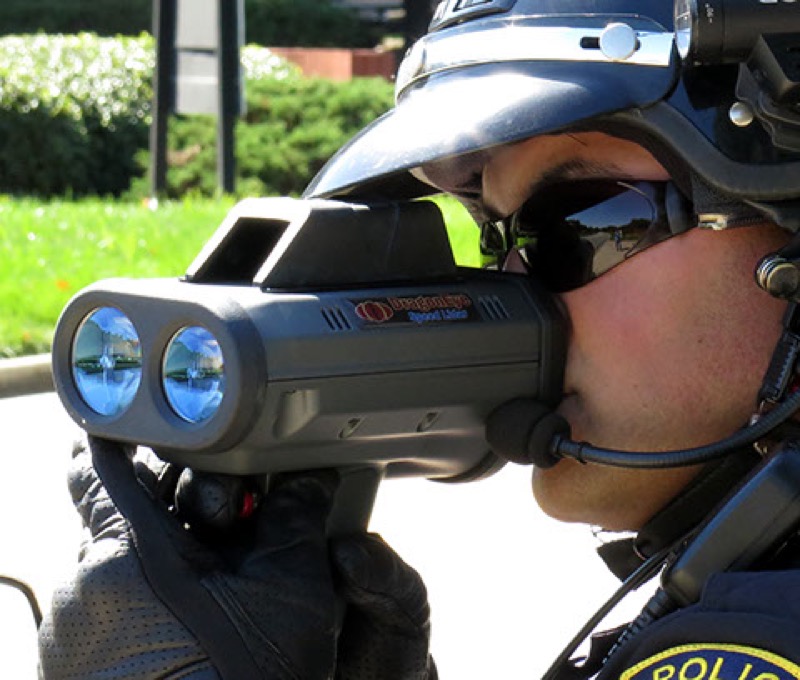
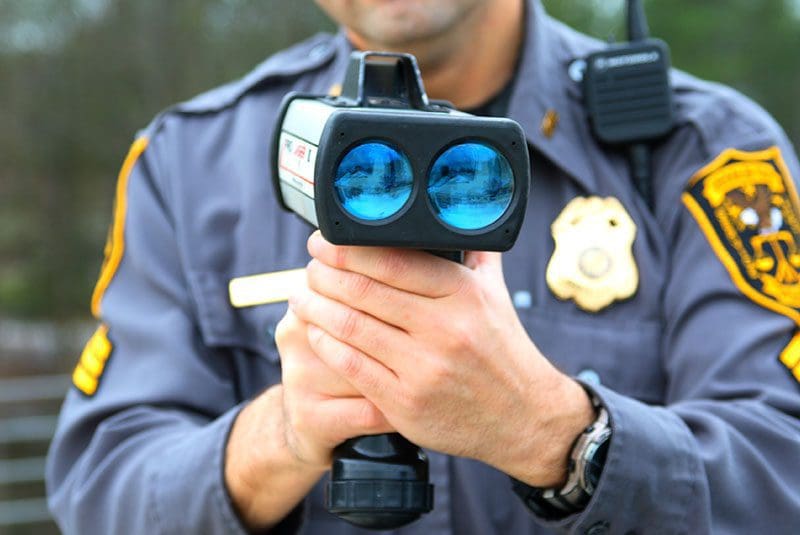
If you’ve ever driven past a speed trap or, worse, received a speeding ticket from a law enforcement officer using a laser gun, you may be curious about how these systems work. Also called a lidar gun, these speed measuring devices are not only very accurate, but they work quickly and reliably to let an officer know how fast you are traveling.

What Is Lidar?

Police LaserInvented in early 1960s, lidar (which is short for Light Detection And Ranging) was designed to measure distances. Lidar devices transmit a series of infrared light pulses that are focused into a beam toward an object. The system measures how long it takes for that pulse to reflect back to the laser receiver (a second lens on the front of the device). Knowing that light travels at a speed of 186,000 miles per second, the computer in the device can calculate how far away an object is, based on how long it took each the pulse of light to return.

The first practical application for lidar was when the National Center for Atmospheric Research used it to measure clouds. In 1971, the crew on the Apollo 15 mission used a laser altimeter to create a map of the moon’s surface.

How Police Laser Works

Police LaserPolice laser guns use a series of pulses to calculate speed. If the operator points the gun at a stationary object, each pulse takes the same amount of time to reflect back to the gun. The system compares these reflection times and looks for a change. When there is no change, the unit will display an object speed of 0 mph.

If the time it takes for each pulse to return is decreasing, the gun knows the object is moving toward the operator. If the reflection time is increasing, then the object is moving away from the operator. The rate of change of signal reflection time is used to determine the speed at which the object is approaching (or moving away from) the operator.

While this sounds complicated, most lidar guns can perform these calculations extremely quickly, often in 0.3 to 0.35 seconds. This incredible speed makes it impossible for a driver to slow down before the officer knows how fast he or she is driving.

Police Laser
With light traveling at 11 feet 9 1/32 inches per nanosecond, police lidar guns use changes in reflection time to calculate how fast a vehicle is traveling.
Police Laser
As the car gets closer, the time it takes for the beam of light to reflect off of the vehicle and return to the gun decreases.

Police Lidar Accuracy

Police LaserAfter inspecting the specification sheets from companies like Stalker Radar, Kustom Signals and DragonEye Technology, most laser measurement systems are rated to provide a beam width of about 2.5 to 3 feet at a distance of 1,000 feet. This accuracy allows a police officer to select a single vehicle for measurement, even in dense traffic.

In terms of speed accuracy, all of the above manufacturers claim that the speed measurement is within 1 mile per hour. Though perhaps irrelevant for a discussion of policing, most laser (and radar) guns have a maximum measuring speed of about 180 to 200 miles per hour.

Why Is It Difficult to Jam Lidar?

Police LaserLaser or lidar jammers try to detect the pulses of light from the officer’s gun and determine the pattern being used. Once they detect the pattern, they transmit a similar series of laser pulses that are intended to confuse the gun and prevent an accurate reading. Laser jammer manufacturers are always working on software updates to support the newest anti-jamming technologies.

Protect Yourself with a Laser Jammer Today

If you are interested in learning about the technologies that are available for your car or truck to prevent officers from using laser guns to measure your speed, drop by your local specialist mobile enhancement retailer today. They can explain the solutions they carry and how they can install them on your vehicle. As always, we ask that you drive safely and obey all traffic laws on your next adventure or commute.

This article is written and produced by the team at www.BestCarAudio.com. Reproduction or use of any kind is prohibited without the express written permission of 1sixty8 media.
Filed Under: ARTICLES, Radar Detectors, RESOURCE LIBRARY

Laser Detectors vs. Laser Transceivers

Laser DetectorsIn any discussion of modern radar or laser detectors, the question of how to handle laser or Lidar speed measurement should be a fundamental and important aspect. More and more law enforcement agencies are switching to Lidar guns because they offer very precise speed measurements of a single vehicle, even at distances as far as 6,000 feet. An officer using a Lidar gun can measure the speed of your car, truck or SUV in as little as 0.3 seconds.

Portable Radar and Laser Detectors

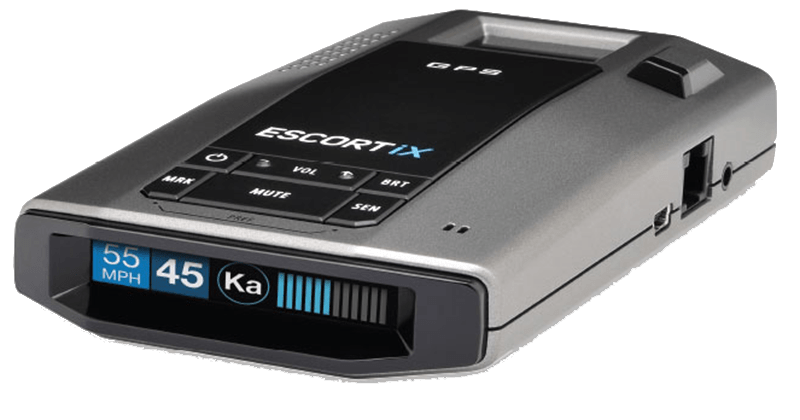
Laser DetectorsWhen it comes to radar detectors, there are two basic options. Portable radar detectors mount to your windshield or rearview mirror and are often powered by a simple cigarette lighter plug. These all-in-one solutions do an excellent job of detecting long-range radar signals, thanks to their high mounting location on the vehicle. When it comes to Lidar guns, though, the best a portable radar detector can do is to advise you when it detects the laser beam.

What’s wrong with knowing that Lidar is being used? If the police officer was targeting your vehicle, he had the speed measurement before you could even put your foot on the brake pedal. Most radar detector users consider the laser detection system on a portable radar detector as an “I am about to get a ticket” warning.

Why do portable radar detector systems have Lidar detectors? The manufacturers hope that the system picks up a laser signal that has been reflected off a nearby vehicle. If you weren’t specifically targeted, this alert may be enough warning to let you slow down to a safe speed.

Custom-installed Radar Detectors

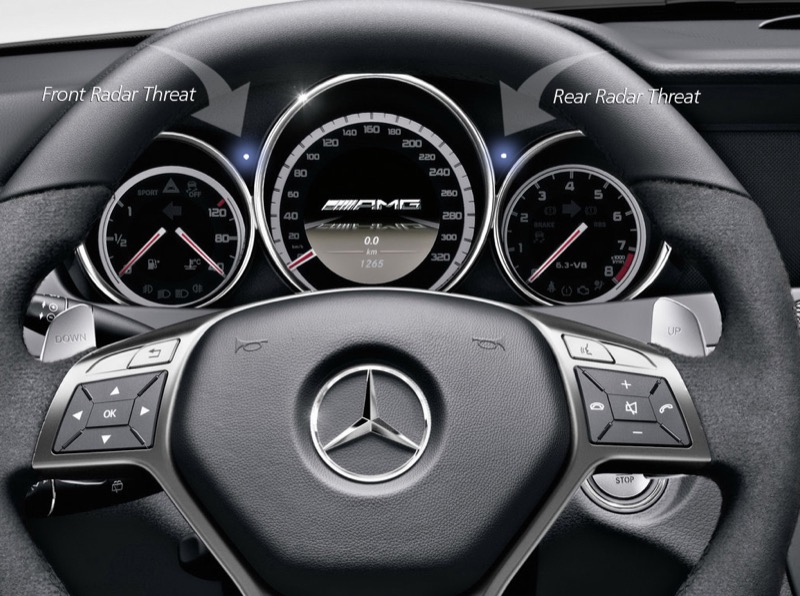
Laser DetectorsThe other option for a radar detector system is one that is custom-installed in your vehicle. In this system, a dedicated radar receiver is mounted behind the plastic front bumper cover and in some vehicles, an extra radar receiver in the rear. Depending on the brand of the detector you purchase, a small display module may be mounted inside the vehicle, or you may have a simple warning LED or two and a speaker system that will alert you to what type of speed measurement system was detected. Custom-installed radar detectors use larger, higher-sensitivity radar receivers to provide excellent performance.

Laser DetectorsWhen it comes to Lidar, a custom-installed radar system can provide defense against laser speed measurements. Here’s why. Many systems include, or have the option to add, laser transceivers that mount in your front grille. In the same way that a portable radar detector includes laser detection, the custom-installed system also monitors the common laser wavelengths for signs of Lidar measurement.

Here is where things change dramatically. Once the system detects a Lidar signal, it immediately transmits random information on the same wavelength to confuse the Lidar gun. If your laser transceivers are installed and aligned properly, the police officer won’t be able to get a speed measurement from your vehicle.

There’s a Part 2 to this Story

If the laser transceiver system simply continued to confuse the officer, he or she will likely recognize what you are doing and may pull you over anyhow. To keep the peace, laser transceiver manufacturers suggest that you slow down to a legal speed, then cancel the laser transmission. This will allow the officer to take a speed measurement and you can carry on your merry way. In most systems, pressing a button on a small remote or control panel will cancel the laser signal transmission.

Lidar Transceiver System Options

Laser DetectorsDifferent manufacturers such as K40, Escort, Al Priority and Stinger each provide distinct laser transceiver solutions. The number of transceivers required for your vehicle depends on its size and design. In most applications, two transceivers on the front or rear of the car or truck will provide good coverage. If you have a larger vehicle, a third transceiver will increase the intensity and coverage of the modified laser signal.

What about DragonEye?

Laser DetectorsIf there has to be a buzzword in the radar detector industry, it would be DragonEye. DragonEye Technology LLC is based in Georgia and is a manufacturer of Lidar speed measurement guns. Their speed measurement systems have proven to be difficult to confuse. Any discussion about what make and model of a laser defense system is capable of preventing a DragonEye gun from taking a measurement is often short-lived. New software updates for the guns are released on what seems like a regular basis. To keep up with this ever-changing technology, Lidar defense system manufacturers have to provide updates for their systems as well.

More important than being able to defend against DragonEye today is the knowledge that the manufacturer you have chosen will continue to provide updates as new Lidar gun firmware is released. Be sure to do your homework and ask your retailer about the frequency of updates, and how easy or complicated it is to install them on your system.

Drive Safely

We hope that this discussion of the difference between laser detection and laser defense systems helps you make an informed purchasing decision. If you do choose a custom-installed radar detector and laser countermeasure system, how the system is installed plays a significant role in how well it performs. Do your homework. Get references. Inspect the work the shop has done on other vehicles. An investment in a custom radar and laser system isn’t insignificant, so be sure it is done right the first time.

As always, the staff and editors at BestCarAudio.com hope that you always drive safely and responsibly. A radar detection and laser defense system isn’t a license to break the law. Stay in control of your vehicle at all times and drive according to the road and weather conditions. We want you as a reader for life.

This article is written and produced by the team at www.BestCarAudio.com. Reproduction or use of any kind is prohibited without the express written permission of 1sixty8 media.
Filed Under: ARTICLES, Radar Detectors, RESOURCE LIBRARY

How Radar Detectors Have Changed Over the Years

Radar DetectorsIf, like us, you have been a car enthusiast for any significant amount of time, you are sure to remember the magazine ads for the windshield-mount Escort radar detectors in the 1980s. They were, relatively speaking, gigantic. The front panel had a large analog signal strength meter and that ubiquitous orange incandescent warning light bulb on the right side. There were only two adjustments: a volume control and a city vs. highway selection switch. They must have done their job, though – after all, Car and Driver, Autoweek, and several adult magazines all gave them glowing reviews! How’s that for marketing to a specific gender?

The radar detector industry in North America is massive. Countless radar detectors are purchased each year, and millions of dollars in potential speeding tickets are averted. The radar detector industry has come a long way and will continue to evolve. This article provides a brief overview of where the industry has come from and where it is going.

Police Radar Gun History

Radar DetectorsAccording to our research, the first radar-based automobile speed measurement systems were put into use in the late ’40s. These massive systems used vacuum tubes and strip charts to log information.

It was the Connecticut State Police that led the charge to adopt radar speed measurement. After testing for a few years, they started issuing speed tickets based on radar measurements in February of 1949. Garden City, New York, was in pace with the Glastonbury police in the quest for more-efficient ways to catch speeders and start issuing tickets as a source of revenue.

Early radar systems operated in the S-band at 2.455 GHz. Unfortunately, these early systems were only accurate to within a few miles per hour and, worse yet, had a range of 150 to 500 feet.

History of Radar Detectors

Radar DetectorsThere are varying claims to the first radar detector. One unit, the Radar Sentry, which was built in Tonawanda, New York, was one of the first commercially available units. The Radar Sentry appeared on the market in 1961 and sold for just under $40. A pair of AA batteries powered it, and the instructions suggested that clipping it to your vehicle’s sun visor worked well as an installation location.

Another early detector, and one that some articles have (perhaps mistakenly) credited as the first, was the Fuzzbuster. Dale Smith, an electronics wizard, decided to design a radar detector after getting a speeding ticket. He felt the ticket was unjust, so he set out to design a device that would detect when the police were using Doppler radar guns to measure vehicle speed. The result was that Smith invented the Fuzzbuster. If you thought two controls on the Escort was fancy, then the Fuzzbuster was the meat and potatoes: A squelch control and a warning light were all you saw. Nothing more. Watch out, Smokey! We can see you!

An Unfair Advantage

As the popularity of radar detectors grew, it is no doubt that police forces across the nation became frustrated that their enforcement tools had become less and less effective. Around the year 2000, two products entered the market to crack down on radar detector use in states and provinces where it was banned: the Spectre and the VG-2 Radar Detector. These products were designed to pick up the leaked radio frequency radiation from radar detectors and alert police. When combined with bans on radar detectors in some states and Canadian provinces, the police had the edge again – for a while.

The logical evolution for manufacturers was to create a new generation of radar detectors that were impervious to detection by the VG-2 or Spectre systems. It wasn’t long before all the name-brand radar detectors became undetectable. The marketing teams had a field day with their new features, and the sales of radar detectors took off again.

Ones and Zeros

Radar DetectorsAt some point, the evolution of radar detectors took a leap into the digital age with the introduction of microcontrollers. These small computers replaced resistors, logic gates, transistors and more to reduce the size of radar detectors. The software running on these miniature computers brought us elaborate displays and a vast increase in system configuration and optimization options.

The real step forward came with the ability to update the software in the radar detector. Combined with performance improvements, software updates could resolve glitches that otherwise required hardware replacement. With updates to our phones and computers seemingly coming out of thin air, credit must be given to the serial ports and USB ports found on recent radar detectors. Yes, updates are a hassle, but without updates, functionality can suffer.

Advanced Signal Processing and Filtering

Another milestone in radar detector performance was the implementation of digital signal processing (DSP). All-digital radar detectors convert the received high-frequency information into the digital domain for analysis and processing. Unlike analog processing, variations in temperate have no effect on DSP technology. Digital processing also offers more precise signal filtering, resulting in fewer false alarms and increased sensitivity. The result of implementing DSP technology was to provide warnings earlier than analog systems, with fewer false alarms.

GPS Locating

Radar DetectorsThe first radar detectors were quite simple. All they had to do was detect the presence of a radar signal. If a signal of any kind were present, the alarm would go off. Door openers at the grocery store and variety store, along with ultrasonic alarms at the local bank, set them off equally successfully. The challenge for radar detector manufacturers became to provide as much warning as possible while reducing the number of false alarms.

Sensitivity adjustments and improved signal filtering helped reduce the false alarms, but the biggest benefit came only recently. Many modern radar detectors, both windshield-mount and custom-installed types, include an on-board computer, GPS receiver and database of known false-alarm locations. As you approach the local bank, the radar detector will ignore the signal from the alarm system or automatic door opener. If you are in a location where a new false alarm pops up, you can add that location to your database.

Internet-connected Technology

With the incredible popularity of smartphones came the opportunity to integrate radar detectors with Internet connectivity. With a cloud-based database, your radar detector system can be updated in real time to the presence of a speed trap or a false alarm. Your phone is paired to the radar detector using a Bluetooth connection, so there is no need for any wires. Once your detector is on and you launch the app, the system will search its database for your location and report any known speed traps, red light cameras or false alarm sources in the area. If another user recently detected a speed trap, the map on your phone will alert you, long before you are in the range of the radar gun. Likewise, if you detect a police officer using a radar gun, anyone else in the area will receive that warning.

False Alarm Prevention

Radar DetectorsModern vehicles include a wide variety of onboard warning systems. Adaptive cruise control, lane departure warning, blind spot monitoring and emergency brake assist systems are increasingly common. These safety systems often use radar systems to measure distances or identify the presence of another vehicle or object. These radar systems can cause false alarms on radar detectors.

In the past, radar detectors only looked for the presence of a radar signal within the X, K or Ka bands. They didn’t care what information was within the signal; just that it was present. Now, different automobile radar systems have signatures. Thanks to extremely fast signal analysis, radar detectors can decide if the signal it is detecting is from a Mercedes, an Audi or the coppers!

What Does the Future Hold for Law Enforcement?

Radar DetectorsAdvanced image processing technology may soon eliminate the need for police to send radar or laser signals at all. Modern camera systems could discern your rate of speed simply by analyzing a video stream in real time. Your speed could be calculated based on the rate of change of the size of your vehicle relative to the objects around it.

Many police departments already own and operate remotely controlled drones. Would it be possible to equip a drone with a radar gun or lidar system? Absolutely! Perhaps their onboard camera system could be integrated into the aforementioned video analysis systems?

Companies have talked about technologies that would allow them to detect whether you are sending text messages from your smartphone. While this seemed like a great innovation a few years ago, the proliferation of voice recognition technology and the wide acceptance of Apple CarPlay and Android Auto squashed this need before the technology was perfected.

As more and more cars are connected to the Internet in real time, it could be possible for law enforcement agencies to communicate directly with your vehicle. This opens up a big can of worms regarding personal privacy. There is no doubt that the police will do everything they can find an excuse for to access the information.

Stay in Touch With Technology

Your local mobile electronics specialist retailer spends a great deal of time training on the latest radar detector technologies. When you decide you want protection from police radar guns, drop in and talk to them. They can suggest a solution that will meet your needs and explain how to get the most out of it.

(header image Fuzzbuster II By dave_z28ca (http://flickr.com/photos/21612624@N00/167903357/) [CC BY-SA 2.0 (http://creativecommons.org/licenses/by-sa/2.0)], via Wikimedia Commons)

This article is written and produced by the team at www.BestCarAudio.com. Reproduction or use of any kind is prohibited without the express written permission of 1sixty8 media.
Filed Under: RESOURCE LIBRARY, ARTICLES, Radar Detectors

  • 1
  • 2
  • Next Page »

Recent Articles

How Do Laser Shifter Systems Work?

January 25, 2026 

Sold as a means of preventing police officers from measuring the speed of your vehicle, laser shifter systems are amazing feats of engineering. Laser-based speed measurement guns … [Read More...]

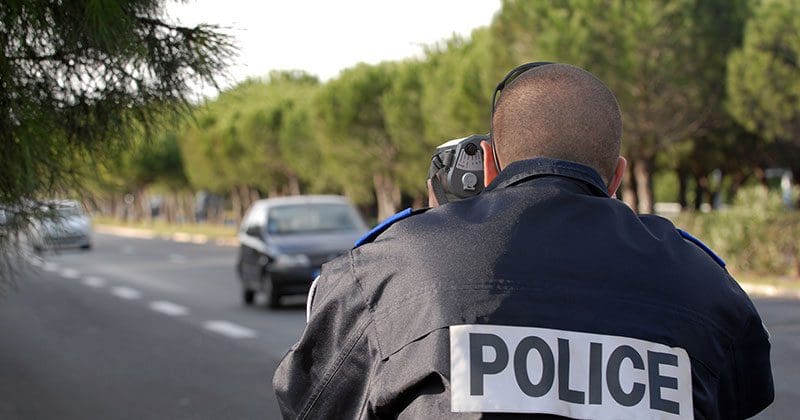
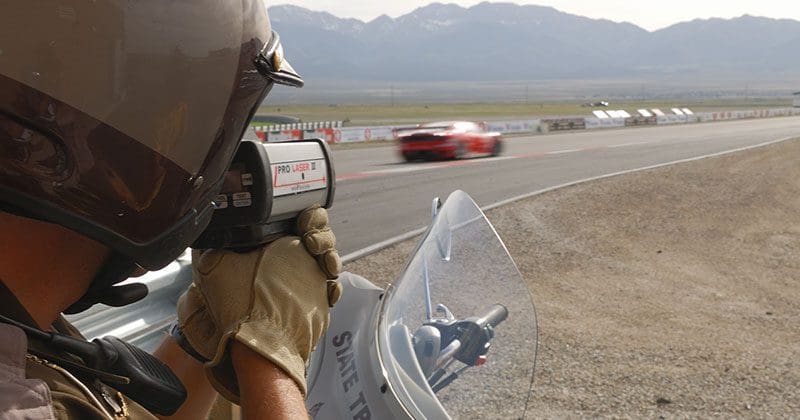
A police officer holding a radar gun at oncoming traffic

How Does a Police Radar Gun Work?

January 11, 2026 

Police officers in North America have been using radar guns to catch speeders since 1949. This relatively simple technology evolved from military applications before World War II, … [Read More...]

KICKER KEYLOC

Product Spotlight: KICKER KEYLOC

December 29, 2025 

There are a dozen or so high-quality line output converters available to help your installer integrate an amplifier into a factory-installed audio system. That said, most of them … [Read More...]

A cop using a detector to see how fast a red car is moving

How Does a Police Laser Gun Work?

December 28, 2025 

If you’ve ever driven past a speed trap or, worse, received a speeding ticket from a law enforcement officer using a laser gun, you may be curious about how these systems work. … [Read More...]

A golden brown BMW on a bridge

Can You Upgrade The Stereo in a Hybrid or Electric Vehicle?

December 14, 2025 

Hybrid and all-electric vehicles are a great platform for stereo system upgrade. While your local specialist mobile enhancement retailer can’t tap into the main battery pack, the … [Read More...]

Subscribe!

Enter your email address to subscribe to our website and receive notifications of new posts by email.

Join 32 other subscribers

Customer Reviews

Subscribe to Our Website

Enter your email address to subscribe to our website and receive notifications of new posts by email.

Durham Location


Get directions to Auto Acoustics

Services

  • Car Audio
  • Driver Safety
  • Motorcycle Audio
  • Remote Starters
  • Truck Accessories
  • Window Tint

Hours

Monday, Tuesday, Wednesday, Thursday, Friday9:00 am – 6:00 pm

Connect With Us

  • Facebook
  • Instagram

Copyright © 2026 Auto Acoustics · Privacy Policy · Website by 1sixty8 media, inc. · Log in


Loading Comments...